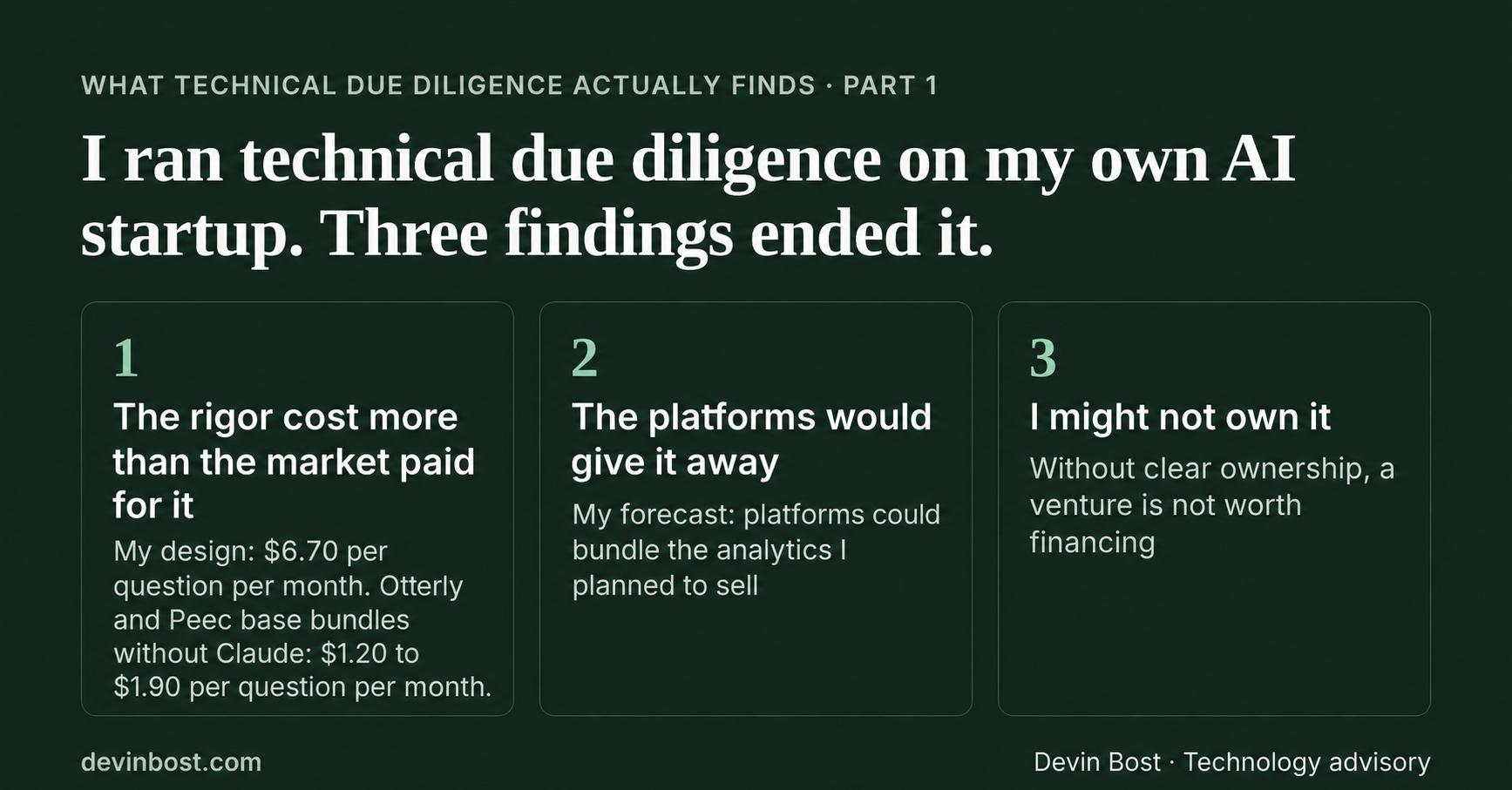
In the spring of 2026 I had an AI startup opportunity I wanted to pursue. Before committing, I gave the plan the same scrutiny I give a startup's plan when an investor hires me to assess it. This article is about what that scrutiny found, and why a finding only matters once it is carried through to a decision. The experiments ran in April, the decision came in June, and the planning model that puts numbers on it was built in October, after the decision, at published October prices; the June decision rested on rougher versions of the same arithmetic.
What the product was
The product was meant to explain why AI answer engines recommend particular companies, and then help a company earn a place in those recommendations. It had two halves.
The analysis half would work out which companies make an answer engine's shortlist for a given question, and why. The execution half would help a customer change its content so that it ranked. Competitors existed, and some already advertised content workflows: Profound, for one, announced audits, briefs and content refreshes for AI search in December 2025. What I had not seen anywhere was the loop closed end to end: generate the content, have a panel of judges score it against evidence and a rubric, revise until it passes, and then measure whether the shortlist moved. If that loop worked, the platform as a whole would have a real advantage. So that is the half I set out to validate first.
The easier half worked
The execution engine's core loop was a content pipeline: generate a draft, have a panel of judges score it against evidence and a rubric, revise, score again. In April I ran it on two pieces of content, with GPT-5.4 as the author and a Gemini 3.1 Pro preview model judging. The surviving records show 193 versions of those two pieces, and the pipeline's own checks passed a little over half of the runs with a recorded result, for about $53 in reconstructed token charges at GPT-5.4's launch rates and Gemini's published rates. Those results were enough to keep going.
Those runs were in April 2026. Newer flagship models have since shipped, so the prototype's quality and economics would need fresh evaluation on the models I would use today.
A working prototype is where a lot of founders stop checking and start building. But it is where due diligence is crucial. The prototype had told me three things I needed to investigate: what it would cost to prove the system worked at commercial scale, whether the platforms it measured would let it live, and whether I had the right to build it at all.
Finding 1: the rigor cost more than the market paid for it
Validating the execution engine properly meant a study, not more runs. Fifty-three dollars of experiments had shown that the pipeline could rewrite two pieces of content until its own judges approved. The claim the startup would sell is that its content changes move a company onto the shortlist, and generating plausible content and proving it changes an answer engine's recommendations are different achievements. Only the second one is worth paying for. To establish it, you need participating companies, a control group, content deployed on real sites, time for the answer engines to pick it up, and enough observations to tell a real lift from noise.
I priced that study from the sample-size math and published rates. Observations of the same company on the same questions are correlated, so the number of independent observations the statistics call for has to be multiplied by a design effect, and the study is sized in companies, not API calls. For a five-percentage-point lift in how often a company appears in recommendations, from 20% to 25%, the initial sizing calculation suggested about 46 participating companies, two baseline and two follow-up measurement waves, and a budget of roughly $60,000 over four months in model, search and capture charges, treatment content, and shared study infrastructure. The illustrative budget range was $35,000 to $130,000, depending on how correlated a company's answers turn out to be, which only a pilot can measure. In the same initial calculation, a ten-point lift suggested a dozen companies and about $20,000. A two-point lift suggested several hundred companies and was out of reach. None of that includes recruiting the companies, deploying the content on their sites, or independent review. And $60,000 is the budget for the design I chose, not a floor: under the same model, asking each phrasing once instead of five times suggested 48 companies and about $34,000, because repeats within a company add observations faster than they add power. A pilot and a statistician's review would settle the sampling intensity and final power calculation.
Twenty thousand dollars is cheap enough that the obvious question is why I did not run the ten-point study. Initially, the timing did not work. I needed the capital elsewhere that year, and a study that cannot be funded through its indexing lag is not a study. The next two findings explain why I did not come back to it.
And the study is one pass. Each major model release could change the answers, and possibly each minor release, depending on what customers cared about. The product had to work on at least OpenAI and Anthropic models, the two providers I intended the product to support, and every additional model a customer asked for would add its own recurring cost. Validation was not a milestone on the build plan. It was an operating cost, and the model vendors set its cadence, not me.
They have since made the point for me. I tested with one author model and one judge model in April. Since then, OpenAI has shipped at least two newer flagship models, GPT-5.5 in April and GPT-5.6 in July, the judge was a preview model with no long-term availability commitment, and the plan needed Anthropic's models as well. Everything the April experiments established about those two models would have to be re-established on the models the product would actually run on.
The harder half
The execution half was the easier one. The analysis half had to explain why a company appears on a shortlist, and why it moved, which meant the system would need to:
- crawl every site in a customer's domain, not just the customer's: all of its competitors, and any newcomer that could appear on the shortlist, along with any page that linked to it;
- re-crawl on an interval and keep enough history to compute what changed;
- re-query the answer engines to see what moved in the shortlist;
- and use a model to work out which changes were responsible.
That is a search engine's crawler, storage and change-detection pipeline with a language model at the end. The crawler would have to be fast and deterministic, like a search engine's; the reasoning was beyond what a single LLM could do.
What the fuller analysis said
Later, with more time, I priced the cost of running the service at current published prices, with every step of the work done by software. A search agent traces why a shortlist moved, an agent prepares the content changes, a browser agent captures what the consumer products show, a cheap model spot-checks the extractor, and an agent writes the monthly report. Each task is priced from steps, tokens and published rates, on a mid-tier model and on a frontier model.
For a bounded service monitoring 25,000 pages and 100 buyer questions across two answer engines, the bill comes to $2,300 to $3,300 a month per customer in model, search and infrastructure charges. Monitoring the answer engines alone, at the sampling the model assumed in order to tell signal from noise, is about $670 of that. The agents that replace the analysts are the cheap part, and most of their cost is the browser captures.
The crawl is the part that scales with ambition. At 25,000 pages it is $70 to $380 of the bill, depending on how the fetching is done and how often pages change. A corpus wide enough to catch every review site, directory, forum and linking page that might influence a shortlist could be ten times that, and the crawl scales with it. One design that bounds it is a citation-driven crawl, which fetches what the answer engines cite and nothing else: a few thousand pages, and whatever is not cited is missed.
The fully automated version also has a problem the cost model cannot price: nobody checks it. The modeled workflow has no independently labeled reference set and no ongoing human review. The judge is calibrated against labels the system wrote for itself, and the monthly report is signed by the agent that drafted it.
What the market was already charging
I had planned to charge $1,000 a month, which is about where the market's enterprise monitoring tiers are reported to start. Self-serve software that monitors AI visibility, from Otterly, Peec, Scrunch, AthenaHQ and others, sells for $29 to $500 a month, with enterprise tiers quoted on request and reported from about $1,000. Prices above that are paid to agencies: $2,000 to $8,000 a month for strategy and content delivered by people, and $10,000 or more for programs with PR and original research.
The Otterly and Peec plans compared here are metered by prompts and models, with one scheduled answer per entered prompt per model each day. Otterly's top self-serve plan works out to about $1.20 per prompt a month for four engines; Peec's to about $1.40 for three. Neither base bundle includes Claude: Otterly sells it as an add-on that takes the figures to $2.30 to $3.00 per prompt a month, and Peec lists Claude only under its custom Enterprise tier. Other models can be added through Peec's dashboard. Customers can allocate prompt quota to alternate phrasings, and daily checks repeat observations over time. These bundles do not specify within-wave replication or a controlled comparison. Their retail price per answer, one to two cents, is below what a mid-tier model with search costs to call through the API. Both vendors document that they collect answers through the platforms' consumer interfaces rather than the APIs (Peec by browser automation, Otterly by posting prompts through the AI search websites, with the API used only for Claude), which is a different cost structure from the one I modeled, and arguably a more faithful one, since it sees what a logged-out user sees.
My design spent about $6.70 per question a month on API charges alone; daily tracking of the same question on the same two engines at the same rates costs $2.60. A daily series of single answers does not by itself establish that a content change caused a shift. My product's claim was that its content moved the shortlist, and a claim like that needs a controlled comparison with enough observations to separate a real shift from run-to-run variation. My design asked each question three ways, five times, in four waves a month, then added daily sentinel checks on 30 of the 100 questions. Across the service, that is 120 scheduled answers plus 36 sentinel answers per question on average each month. The extra checks are concentrated on the sentinel questions. A separate crawl of 25,000 pages was meant to help explain what moved. The market prices I compared were for monitoring. In hindsight, the design conflated monitoring with a proof study, and under this initial sizing model the five repeats added more cost than their contribution to power justified. Everyday monitoring could use the selected plans' daily schedule, with proof handled in a study sized by a pilot.
Strip the rigor to match them, crawl only what the engines cite, and share infrastructure across customers, and the fully automated service falls to roughly $600 to $1,500 a month per customer, the higher figure if it still generates content. At the $1,000 I had planned to charge, that is a modest margin without the content features and a loss with them, before any fixed cost. It is also one of them: a monitoring tool with an attribution feature and generated drafts, competing on distribution against funded incumbents and the model vendors themselves. That is the second finding.
Finding 2: the platforms would give it away
In May 2026, OpenAI opened a self-serve ads manager for ChatGPT with conversion tracking already live, and Modern Retail reported that it was rolling out product-feed campaigns: sponsored product recommendations generated from a retailer's catalog, in the same placement as its other ads. I architected and built much of Bed Bath & Beyond's sponsored product search platform, and I know what a platform ships after it starts selling placements. It ships analytics, so advertisers can see what the placements earned them. The measurement is what keeps the budgets coming back.
Advertiser analytics are not yet the product I was proposing to sell: conversion tracking measures what happened after a paid placement, and OpenAI says its ads do not influence its answers. My forecast was that engines selling placements could later offer analytics explaining why a company was or was not recommended organically. The vendor that owns the answer engine could build that from the inside, with the data and the relationship, and bundle it with the ad spend. This was my assessment of the competitive risk, not an announced roadmap. OpenAI has the distribution, the data and the relationship. My startup would have had a monthly invoice and a crawler. An announcement of vendor-native visibility analytics could upstage the idea on the day it was made, and I expected other engines selling placements to follow. Anthropic has said Claude will stay ad-free, which limits this finding to engines that sell placements.
By the time I wrote this, OpenAI had added product carousels in August and, in October, third-party attribution partners for its ads. Those announcements expanded advertising measurement. Organic visibility analytics remained my forecast.
The go-to-market risk was not something a cost model could price. It was a judgment from having built much of a sponsored product search platform and considering what the model vendors could choose to build. A judgment is still a finding, as long as the record makes it clear.
Finding 3: I might not own it
Any version of the product, lean or not, needed one more thing: the right to build it. The prototype's results had sent me back to the licensing review, and this time I went deeper. Part of licensing due diligence is confirming that the founder actually owns the intellectual property. After reviewing an existing agreement, I found that I could not say with confidence that I would own what I was about to build.
Clearing that up would have meant asking the company in question for a carve-out. However, due to their existing priorities, I did not expect that to be simple, and after the first two findings, the economics were not strong enough to justify the effort. A venture that starts with a dispute over who owns it is not one an investor should fund.
Without clear ownership, a venture is not worth financing. If the idea gets big, everyone wants a piece of it, and anyone holding an agreement that grants them even partial ownership of what you built, even one signed fifteen years earlier, has every incentive to come and claim it.
Technical due diligence is not only about whether the system can be built. It is about whether the licenses and agreements grant the authorization to build it.
The decision
I abandoned the opportunity.
The product offered real value, and a working execution engine would have been hard for competitors to match. But the arithmetic did not close for the product as designed. Run entirely by software, the service cost $2,300 to $3,300 a month per customer, against the $1,000 a month I had planned to charge. Redesigned to match the market's sampling and scope, it would have competed with the market's products at their published prices and it would have been one of them, with the model vendors positioned to bundle the only features that made it different. The expected costs left too little profit to justify the risk. The lean version does earn a margin at $2,500 to $3,000 a month; whether buyers would pay that for a monitoring tool with drafts and attribution, against funded incumbents and the vendors themselves, was a bet I was not willing to make, and that is a judgment about my own appetite for risk as much as a finding about the market.
The IP finding meant that even a profitable version would have been built on ground someone else could claim, and clearing it would have taken a fight the economics did not justify.
An assessment that stopped at "the study would cost $60,000" would have left the commercial question unanswered: whether the opportunity was still worth pursuing at that cost and risk. A finding only matters once it is carried through to the decision.
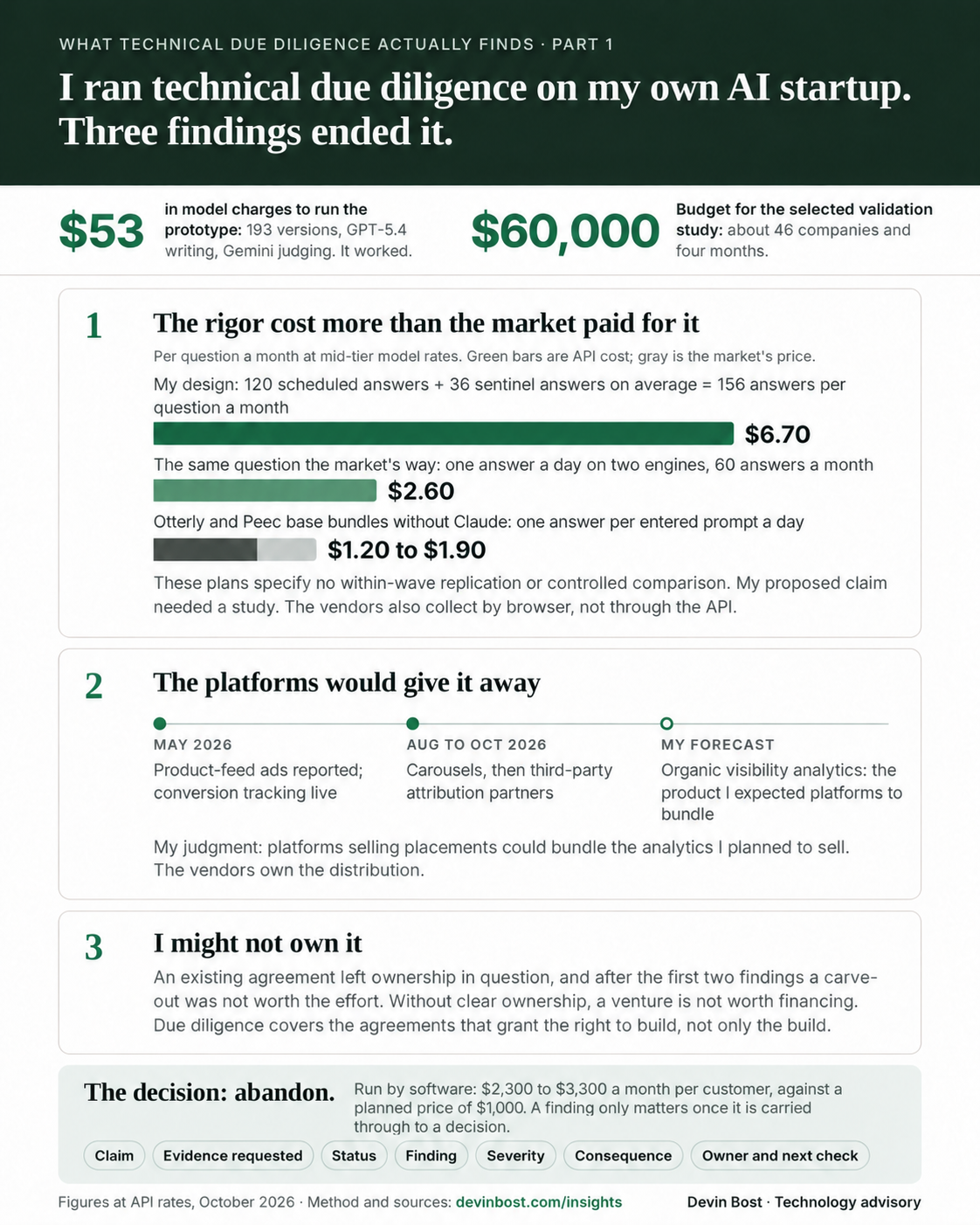
Carry the finding through to the decision
I record every finding in seven fields, including its consequence and who owns the next check. These are the records for my own case.
| Field | Validation economics | Platform risk | IP ownership |
|---|---|---|---|
| Claim | The opportunity can earn enough profit to justify its risk | The product can reach customers before the model vendors give the same analytics away | The founder owns the intellectual property the business depends on |
| Evidence requested | A powered study design, sized in participating companies, with its observation volume and cost; a delivery cost model at planned volume, priced from published rates | Vendor announcements and roadmaps; what comparable platforms shipped after sponsored placements | Any existing agreement that could reach ownership of the product; model, data and component licenses |
| Status | Estimated | Judgment from prior platform experience, with hard signals: product-feed ads in ChatGPT reported in May 2026, and OpenAI's conversion tracking (May) and third-party attribution partners (October) for its ads | Agreement reviewed |
| Finding | The initial sizing calculation suggested about 46 participating companies and a budget of roughly $60,000 for the selected five-point scenario, with validation repeated as models change; with every analysis step automated, delivery costs $2,300 to $3,300 per customer per month as designed, against a planned price of $1,000; matched to the market's sampling and scope it costs $600 to $1,500 and is a monitoring tool among many | My forecast: engines selling placements could extend advertising measurement to organic visibility analytics. A vendor-native release could upstage the product, and the vendors own the distribution | An existing agreement left ownership of the product in question, and after the first two findings a carve-out was not worth the effort |
| Severity | High: changes the decision to proceed | High: changes the decision to proceed | High: changes the decision to proceed |
| Consequence | Abandon: expected profitability does not justify the risk | Abandon: a subscription product cannot win a go-to-market race against the platform it measures | Abandon: without clear ownership, the venture is not worth financing |
| Owner and next check | The founder records what would have to change before reconsidering: a measurement design the market will pay for, or evidence that buyers will pay for the measurement | The founder; watch for vendor-native visibility analytics. Conversion tracking and third-party attribution have since shipped for ads | The founder; any future venture gets an agreement review before the first line of code |
Status and severity stay separate. An estimate can identify a serious economic problem while still depending on assumptions that need checking, and a judgment can be severe enough to decide, as long as the record calls it a judgment. If a requested record is missing, I assign someone to answer the open question by a set date.
What I would look for in any AI startup's plan
- A powered study that would establish the product's central claim, sized in customers rather than API calls, with its success criterion stated in advance and priced separately from the cost of running the product, with a retest cadence tied to the model vendors' release schedules.
- The cost of the fully automated version, priced from published rates, twice: at the sampling volume the product promises, and at the sampling the market's products actually run. The difference is the price of the rigor, and the market may not pay it. Then ask who checks the automation: independent labels, coverage and ongoing review, or the system grading itself.
- What buyers already pay for the nearest substitute, from published price lists, before the founder's price assumption is accepted. Then the delivery cost at that price, not at the founder's.
- Whether the founder's evaluation scores are stable. Repeat scoring and quantify the uncertainty. The reported comparison needs enough precision to resolve the effect being claimed.
- A response-level ledger of every model call: provider response ID, model, timestamp, tokens, tool calls. If the founder cannot produce one, the cost claims are memory, not evidence.
- Whether the platform the product measures has a reason to ship the same thing itself. Review the advertising measurement it already offers, and record any expectation of bundled organic analytics as a forecast.
- Every agreement the founders have signed that touches intellectual property, including the ones from previous employers, read before the architecture depends on the answer, with an honest view of whether a carve-out is realistic and whether the rest of the plan is strong enough to justify asking for one.
I do this work for investors and for the firms that run due diligence on their behalf: architecture, cost to production, validation, licensing and benchmarks, carried through to a decision the way this one was. If you are assessing an AI company and need the technical side done properly, let's talk.
Next in the series: an angel investor, an education startup, and a plan that got smaller.
Appendix: What the Records and the Planning Model Contain, and What the Figures Can Support
What the April records show
The experiment counts come from a later read-only recovery of the retained run records. No experiments were rerun. I ran the original experiments and directed the recovery, so the retrospective is not independent.
The retained records cover April 4 to 8, 2026, with 15 further April 9 runs surviving only as registry entries. They show 193 distinct authored versions of two pieces of content (88 and 105; 90 full rewrites and 103 targeted edits), produced by gpt-5.4-2026-03-05, across 151 recorded runs from April 4 to 8 (the April 9 registry entries are not among them), of which 137 have a recorded result: 73 pass, 35 blocked, 19 revise, 10 failed. Judging left 196 retained responses from a single Gemini 3.1 Pro preview configuration. The 193 versions are dependent revisions of two targets, not 193 independent test cases, and the 196 judging responses are a lower bound, since some earlier scored outputs lack response IDs.
Authoring consumed 20.5 million input tokens (4.9 million of them cached) and 556,000 output tokens; judging consumed 515,000 input and 231,000 output tokens including the judge's reasoning. At GPT-5.4's launch rates ($2.50 per million input, $0.25 cached, $15 output) and Gemini's currently published rates ($2, $0.20 and $12), that is $52.58 to $52.79 in token charges from the unrounded token counts (the rounded counts above give $52.37), with the range covering how cached tokens are allocated between authoring and two research calls. Gemini's rate is its standard-context price; the higher long-context rate did not apply at these call sizes. No dollar ledger survives, so this prices the retained tokens; it does not establish the complete April bill, and records from June, when the assessment was made, were not recovered.
The proof study
The proposed study would test the central claim by randomizing participating companies to a treatment arm, whose content the engine changes, and a control arm, and measuring inclusion in the answer engines' recommendations for a panel of buyer questions in two baseline waves and two follow-up waves after deployment and an indexing lag. Each company is measured on 100 questions, asked three ways, five times, on two engines, per wave.
Sizing starts from the two-proportion sample size (pooled variance, two-sided 5%, 80% power): 1,094 independent observations per arm per engine to detect 20% to 25%, 294 for 20% to 30%, 6,510 for 20% to 22%. Observations within a company are correlated, so that figure is multiplied by a design effect of 1 + (cluster size − 1) × ICC, where the cluster is a company's 3,000 follow-up observations per engine and the ICC is the intra-company correlation, unknown before a pilot. The study is then sized in companies. The table retains this per-engine reference calculation and credits no precision gain from combining engines. Final power for an average across engines would use their estimated covariance alongside the other design assumptions.
Costs are observations at $0.0432 each (mid-tier model with search, extraction, 10% attempt allowance); 2% of observations also captured on the consumer surface by a browser agent at $0.67; eight content briefs per treatment company at $88 each (generation, panel judging, arbitration and replay as modeled); 24 attribution investigations per treatment company per month at $1.01, which test the attribution method against content changes the study itself made; and $2,000 a month of shared study infrastructure for four months. Study calculations use $0.0432 per observation, $88.46 per brief and $1.0112 per investigation as planning inputs. The observation rate is rounded from the service model's $0.04323, and these stated study inputs reproduce the table below.
| Lift scenario | ICC 0.01: companies, cost | ICC 0.02: companies, cost | ICC 0.05: companies, cost |
|---|---|---|---|
| 20% to 30% | 8, $16,653 | 12, $20,979 | 30, $40,447 |
| 20% to 25% | 24, $33,958 | 46, $57,753 | 112, $129,137 |
| 20% to 22% | 136, $155,095 | 266, $295,700 | 656, $717,515 |
Frontier-priced captures ($3.40 instead of $0.67) add about half again to the five-point case. The baseline waves are costed but their contribution to power is not credited, which is conservative for that choice and does not make the whole calculation conservative. Excluded, as labor without a measured basis: recruiting the companies, deploying the content on their sites, study design and pre-registration, independent statistical review, and human adjudication of a sample. Unpriced risks: that the engines do not index the changes within the study window, and the terms-of-service exposure of browser captures.
What the sizing does not settle. The ICC range is illustrative: the April records say nothing about how correlated recommendation outcomes are across companies, questions, phrasings and waves, and only a pilot would. With a dozen companies, six per arm, a normal approximation with a design effect does not substantiate 80% power on its own; the analysis method and its small-sample corrections would have to be fixed in advance, along with the success criterion across engines: the one I would prespecify is the lift in the average inclusion rate across the two engines, with per-engine results reported but not required to pass separately, since requiring success separately on each engine can require a larger study, depending on their relationship and the success rule (80% power on each engine does not by itself establish 80% power on both), the mapping from answers to company outcomes (one answer can name several participating companies), the handling of competing companies in the same market, whose content changes can displace each other, and the population the five points are claimed for. The sampling intensity is a choice as well: under the same initial model, asking each phrasing once instead of five times suggested 48 companies and about $34,000, because repeats within a company add observations faster than they add power. The $60,000 is the budget for the design as chosen, not a minimum.
What the planning model contains, and what I left out
The cost figures in this article come from a planning model built after the decision, using published API prices checked on October 17 and 19, 2026.
The model prices a bounded managed service at steady state: 25,000 monitored pages re-fetched four times a month; 100 buyer questions, each asked three ways and repeated five times, across two answer engines, four times a month, plus a daily sentinel check of 30 questions, two observations each on each engine (3,600 a month; 15,600 observations in all); eight content briefs a month, each taking ten candidates through four rounds of a five-judge panel; and model-change re-testing after four releases per engine per year. At published rates the model and search charges are $1,564 a month per customer: monitoring the answer engines (probes and extraction) $674; content generation and judging $708, from a planning allowance of $88.46 for each of eight briefs; and model review of changed pages from the crawl $182 at the model's crawl assumptions. Infrastructure for fetching, storage and the application is $502. The re-testing probes, a full 3,000-observation wave after each of eight releases a year, add $86.
The content allowance is $707.68 before rounding. Its approximate task breakdown is 320 drafts (eight briefs, ten candidates, four rounds) at about $0.054 each (12,000 input and 3,000 output tokens at mid-tier rates), 1,600 panel judgments at about $0.30 (20,000 input and 2,000 output tokens at frontier rates), and 2,400 replays at about $0.06, with arbitration and a 10% attempt allowance included in the budget. The replay token budgets and arbitration workload are not specified here, so these task counts do not independently reconstruct the exact per-brief allowance. The totals below retain it as a planning input.
The model also contains labor lines: analyst, editor, QA and capture hours per customer, and a separate development budget built on 300 specialist hours. I have left those out of this article. They are planning assumptions with no measured basis, and the argument does not need them: the service as designed fails at software prices with the labor set to zero, and no staffing assumption can improve on zero.
The automated build
Each human line in the model is replaced by an agent task whose volume matches the work removed, priced from steps, tokens and published rates, on a mid-tier model ($2 per million input tokens, $10 output, cached input at $0.10) and a frontier model ($10 and $50, cache at 10% of input). A quarter of agent input is assumed cached, as the April records showed.
| Agent task | Volume per month | Steps × tokens (input / output) | Mid-tier | Frontier |
|---|---|---|---|---|
| Shortlist-change investigation with search | 24 | 15 × 30,000 / 1,500, plus 10 searches | $24 | $113 |
| Content implementation preparation | 8 | 10 × 40,000 / 2,000 | $6 | $33 |
| Monthly report and 300 extraction spot-checks on a cheap-tier model ($0.10 and $0.50 per million) | 1 + 300 | 5 × 50,000 / 3,000; 1 × 10,000 / 500 | $1 | $3 |
| Consumer-product capture by a browser agent | 200 | 20 × 20,000 / 300 | $134 | $680 |
| Model-change impact analysis | 8 per year | 30 × 60,000 / 3,000 | $2 | $12 |
| Agent runtime, browsers, proxies and logs | allowance | $300 | $300 |
Automated delivery cost per customer per month: $1,382 model and search excluding the crawl + the crawl at $67 to $383 (next section) + $300 application infrastructure + $300 agent infrastructure + $86 re-testing probes + $168 or $841 agent tokens = $2,303 with mid-tier agents and the low crawl assumptions, $3,293 with frontier-priced agents and the high crawl assumptions; monitoring and content stay at their fixed budgets in both. Model and search charges are roughly three quarters of it. The token counts per agent step are planning values; April's authoring averaged 106,000 input tokens per retained version, so 20,000 to 60,000 per step is not generous. Non-cached input is priced at the ordinary rate; OpenAI's current list prices cache writes at 1.25 times input, so if all of the agents' non-cached input were cache writes, the agent tokens would rise by about $36 a month on the mid-tier model and $179 on the frontier model. A scripted capture instead of a browser agent would cost cents per capture but is brittle and raises terms-of-service risk.
What the market charges
Prices read from vendor pages on October 19, 2026, and from pricing guides dated July to September 2026.
| Category | Monthly price | Examples |
|---|---|---|
| Self-serve AI-visibility monitoring | $29 to $500 | Otterly $29 / $189 / $489 (15 / 100 / 400 prompts); Scrunch $300 / $500; Peec $95 / $245 / $495 (August roundup); AthenaHQ $295 monthly; Semrush toolkit $99 per domain |
| Enterprise monitoring | Custom; reported from about $1,000 | Profound (trial, then custom); Otterly enterprise; Peec enterprise |
| Productized and monitor-and-maintain services | $500 to $2,500 | Template packages; basic monitoring with quarterly schema and FAQ updates |
| Mid-market managed GEO retainers | $2,000 to $8,000 | WebFX from $3,000 with a six-month commitment; RevvGrowth $3,000 with 10 articles a month and $8,000 with 40 |
| Enterprise programs | $10,000 to $30,000+ | Multi-platform campaigns, PR, original research; Omniscient full-service from $10,000 on an annual engagement |
Gross margin per customer per month for the automated service as designed, before any fixed cost, at the low end (mid-tier agents, low crawl assumptions, $2,303) and the high end (frontier agents, high crawl assumptions, $3,293):
| Price per customer per month | Low end | High end |
|---|---|---|
| $500 (self-serve mid-tier) | ($1,803) | ($2,793) |
| $1,000 (planned price; reported enterprise entry point) | ($1,303) | ($2,293) |
| $1,500 (enterprise monitoring) | ($803) | ($1,793) |
| $3,000 (mid-market retainer, entry) | $697 | ($293) |
| $5,000 (mid-market midpoint) | $2,697 | $1,707 |
| $8,000 (mid-market top) | $5,697 | $4,707 |
Fixed costs (a product and engineering team, sales, and validation after each model release beyond the re-testing probes included above) come on top and are not estimated here. The retainer prices in the last three rows are paid to agencies for strategy and content delivered by people, which the automated service does not provide.
Scaling factors: how the competitors meter, and what the design cost per question
The selected Otterly and Peec plans state daily tracking with one answer per entered prompt per model. Scrunch counts each platform a prompt runs on against its prompt-variant allowance. Its documented schedule is daily for a prompt's first two weeks, then every 72 hours, with manual refresh available. The $1.43 allocation below is per question-month on two platforms, with that cadence. A per-answer allocation would depend on prompt age and manual collections, so none is compared here. Retail price per prompt-month and per answer:
| Plan | Monthly price | Prompt quota and scheduled collection | Answers per month | Per prompt-month | Per answer |
|---|---|---|---|---|---|
| Otterly Premium | $489 | 400 × 4 × 30 | 48,000 | $1.22 | $0.010 |
| Otterly Standard | $189 | 100 × 4 × 30 | 12,000 | $1.89 | $0.016 |
| Peec Advanced | $495 | 350 × 3 × 30 | 31,500 | $1.41 | $0.016 |
| Peec Starter | $95 | 50 × 3 × 30 | 4,500 | $1.90 | $0.021 |
| Scrunch Growth (custom prompts) | $500 | 700 prompt variants (question × platform); daily for the first two weeks, then every 72 hours, with manual refresh available | Varies with prompt age and manual refreshes | $0.71 per variant-month; $1.43 per question-month on two platforms | Not compared; cadence varies |
A mid-tier answer with search (9,500 input tokens including the returned search results and 1,000 output at $2 and $10 per million, one search at $0.01, extraction at $0.0003, all with a 10% attempt allowance) costs $0.043 through the API; a cheap-tier answer ($0.10 and $0.50 per million) $0.013; a Perplexity Sonar answer through the Agent API ($0.25 and $2.50 per million, $0.0025 a search) $0.008. Otterly's and Peec's retail prices per answer, $0.010 to $0.021, sit below the mid-tier API cost and around the cheap-tier cost. Both vendors document their method: Otterly posts prompts through the AI platforms' websites and uses the API only for Claude; Peec uses browser automation through the web interfaces, which it describes as the logged-out user's experience. Their costs are therefore not API costs, and the comparison with my API-priced design is a comparison of cost structures, not of margins.
The design in this article spent, per buyer question per month: 3 phrasings × 5 repeats × 2 engines × 4 waves = 120 scheduled answers, plus 36 sentinel answers on average, or 156 answers at mid-tier rates, $6.74. The sentinel checks cover 30 of the 100 questions, so that average is an allocation across the service. Daily tracking of the same question with one answer on each of two engines costs $2.59 at mid-tier rates and $0.78 on a cheap tier: a 2.6-fold difference at the same rates and engines, before crawling and content production. The selected plans' published prices for a question are $1.22 to $1.90 a month on base bundles of three or four engines without Claude, $2.32 to $2.98 on Otterly with Claude added, and $1.43 on Scrunch for two platforms, collected every 72 hours after the first two weeks, with manual refresh available.
Crawl cost by corpus size, per customer per month, with four fetches a month, changed-page triage, model review of a share of changed pages, and snapshot storage. The model's original assumptions ($0.002 a fetch, 10% of fetches changed, frontier review at $0.30) are the high case; the low case is self-hosted fetching at $0.0005, 3% changed and mid-tier review at $0.06; central is $0.001, 5% and frontier review. In every case, changed pages get a cheap-model triage at $0.0015, 5% of them are escalated for model review, both carry a 10% allowance, and each fetch stores a 100 KB snapshot for twelve months at $0.015 per GB-month (request operations not priced):
| Pages that might influence the shortlist | Crawl, low | Crawl, central | Crawl, high | Automated service total, low to high |
|---|---|---|---|---|
| 5,000 | $13 | $39 | $77 | $2,250 to $2,986 |
| 25,000 (as designed) | $67 | $193 | $383 | $2,303 to $3,293 |
| 100,000 | $267 | $770 | $1,533 | $2,503 to $4,443 |
| 250,000 | $666 | $1,926 | $3,833 | $2,903 to $6,743 |
| 1,000,000 | $2,666 | $7,702 | $15,332 | $4,903 to $18,242 |
The crawl scales linearly at $0.003 to $0.015 per page per month. A design that compared every question with every page would scale as their product (1,000 questions × 25,000 pages at $0.03 is $750,000 a pass); the automated build avoids it by investigating shortlist changes, about 24 a month, rather than comparing pages with questions. A citation-driven crawl bounds the corpus at the pages the engines cite, a few thousand, and misses uncited influences.
A lean configuration, not a demonstrated minimum: 100 questions tracked daily with one answer on two engines at mid-tier rates ($259), content generation and judging as designed ($708), a citation-driven crawl of 2,000 pages at the central assumptions ($15, fetching and storage included), the agent tasks ($168), shared application and agent infrastructure at $250 instead of the $600 per-customer allowance, and the model-change re-testing probes ($86) come to $1,487 a month. Without content generation, $779; with cheap-tier daily monitoring probes, about $182 less, keeping re-testing probes at the original rate. Gross margin before fixed costs at the planned $1,000: 22% without content generation and a loss with it; at $2,500, 41%; at $3,000, 50%.
What the figures can support
They are planning figures from published rates and explicit volumes, not quotes. The softest inputs are the token counts per agent step, the corpus size and the infrastructure allowance. Pricing the agents on a frontier model instead of a mid-tier one adds about $670 a month, which does not change the comparison with software prices. The API sampling, including the sentinel checks, cost 2.6 times as much as daily tracking of the same questions on the same two engines at the same rates. Crawling and content production added separate costs. The $6.74 API observation cost per question-month was also between three and a half and five and a half times the allocated retail subscription prices of the selected Otterly and Peec base bundles, which cover four and three engines respectively without Claude. That compares API cost on two engines with retail subscription allocations on broader engine bundles, not equivalent services or vendor margins. Removing the extra sampling and reducing the crawl produces a product competing with the market's products at their prices. The attribution feature and generated drafts cost a few hundred dollars a month to run and are the only differentiation; whether buyers pay $1,500 to $3,000 for them is untested, and Finding 2 is my forecast that the vendors could bundle them. The competitor prices are published list prices and guide ranges, not negotiated deals, and the agency ranges are reported rather than verified.
Sources
- OpenAI, Introducing GPT-5.4 (March 5, 2026 launch pricing): https://openai.com/index/introducing-gpt-5-4/
- OpenAI API pricing: https://developers.openai.com/api/docs/pricing
- Anthropic API pricing: https://platform.claude.com/docs/en/about-claude/pricing
- Google Gemini API pricing: https://ai.google.dev/gemini-api/docs/pricing
- xAI API pricing: https://docs.x.ai/developers/pricing
- Perplexity API pricing: https://docs.perplexity.ai/docs/getting-started/pricing. Agent API model token rates: https://docs.perplexity.ai/docs/agent-api/models
- Cloudflare R2 pricing: https://developers.cloudflare.com/r2/pricing/
- Modern Retail, "OpenAI makes it easier to run shopping ads in ChatGPT" (May 12, 2026): https://www.modernretail.co/technology/openai-makes-it-easier-to-run-shopping-ads-in-chatgpt/
- Digiday, "OpenAI brings product carousels to ChatGPT ads" (August 6, 2026): https://digiday.com/marketing/openai-brings-product-carousels-to-chatgpt-ads/
- Otterly.AI pricing: https://otterly.ai/pricing
- Scrunch pricing: https://scrunch.com/pricing
- Peec AI pricing: https://peec.ai/pricing
- Profound pricing: https://www.tryprofound.com/pricing
- AInora, "Best AI Visibility Tracking Tools 2026: Verified Pricing Compared" (prices read August 26, 2026): https://ainora.lt/blog/best-ai-visibility-tracking-tools-2026
- Pepper, "How much does generative engine optimization cost in 2026?" (September 2026): https://www.pepper.inc/blog/generative-engine-optimization-cost/
- The Digital Elevator, "AEO and GEO Pricing Guide" (updated July 23, 2026): https://thedigitalelevator.com/blog/aeo-and-geo-pricing-guide/
- Scrunch help center, "Scrunch Prompt Strategy Guide" (prompt variants are counted per platform): https://helpcenter.scrunchai.com/en/articles/12872036-scrunch-prompt-strategy-guide. Collection schedule and manual refresh: Data FAQs (September 5, 2026)
- Otterly help center, "How OtterlyAI collects data?": https://help.otterly.ai/how-otterlyai-collects-data
- Peec AI docs, "Welcome to Peec AI" (collection by browser automation): https://docs.peec.ai/intro-to-peec-ai
- OpenAI, "New ways to buy ChatGPT ads" (May 5, 2026): https://openai.com/index/new-ways-to-buy-chatgpt-ads/
- OpenAI, "Building advertising for the way people use AI" (October 5, 2026): https://openai.com/index/new-chatgpt-ads-format-and-measurement/
- Anthropic, "Claude is a space to think" (February 4, 2026): https://www.anthropic.com/news/claude-is-a-space-to-think
- Profound, "Profound Workflows public beta" (December 11, 2025): https://www.tryprofound.com/blog/profound-workflows-public-beta
Devin Bost is an AI Architect at IBM, where he helps enterprise customers take agentic AI from concept to production at scale. He has 18 years of software engineering and architecture experience, including conversational AI work in education technology since 2016, and he architected and built much of Bed Bath & Beyond's sponsored product search platform from the ground up. He does technical due diligence for investors and enterprise buyers. LinkedIn
The experiments described ran in April 2026; the assessment and the decision followed in June. Cost figures are from a planning model built after the decision, at prices published in October 2026, with the labor lines excluded.